
Our parish bears the name of two women who died on the same night in the early summer of 1918, in a forest east of the Ural mountains, at the bottom of a disused iron mine. One was Grand Duchess Elizabeth Feodorovna Romanov, the granddaughter of Queen Victoria, the sister of the last Tsarina (a title given to the matriarch wife of a Tsar), and the abbess of a convent in central Moscow. The other was a former lady’s maid named Barbara Yakovleva, who had taken the veil under Elizabeth and refused to be parted from her at the end. Their bones now rest in Jerusalem. Their feast falls in July. Their icons are placed in our church.
This article, honouring the life of our patron saint Elizabeth, is in three main parts:
- Facing loss
- Encountering surrender
- Finding love.
These are examples of the gospel she lived.
“But what things were gain to me, these I have counted loss for Christ.”
Ella
Elizabeth Alexandra Luise Alice was born on the first of November 1864, at Bessungen, Germany, in the region of the Grand Duchy of Hesse and by Rhine.
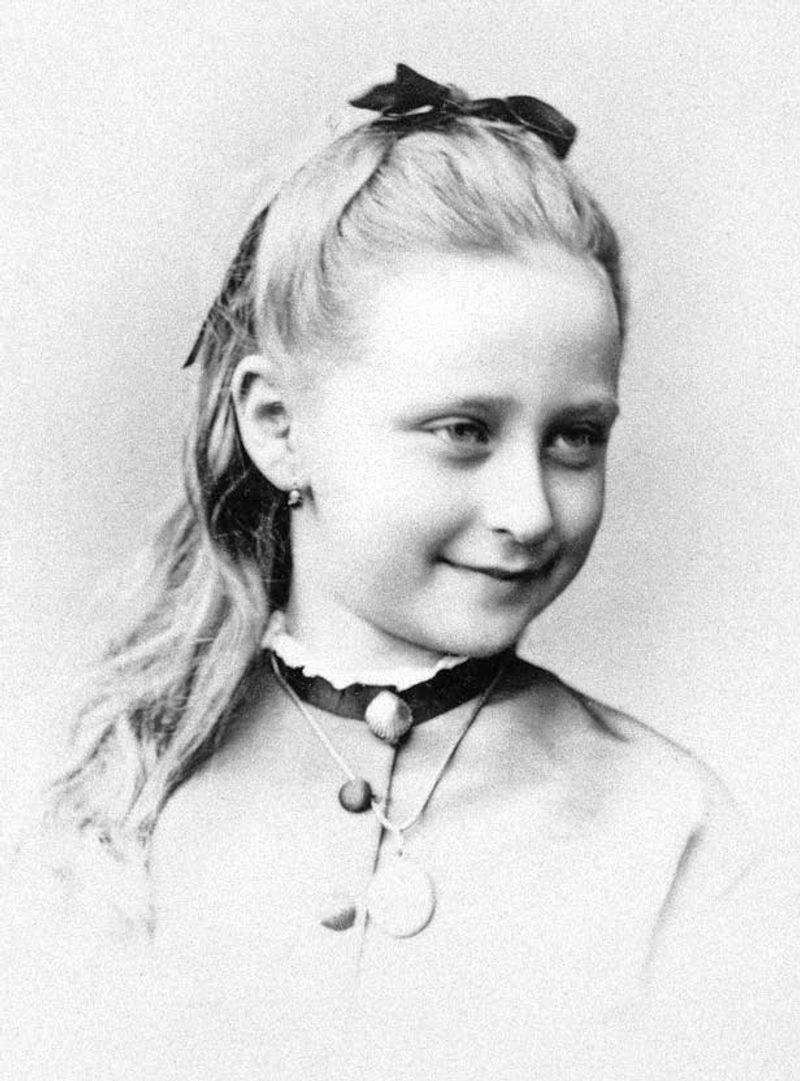
Her mother was Princess Alice of the United Kingdom, the second daughter of Queen Victoria. Her father was Ludwig (Louis) IV, Grand Duke of Hesse of German royalty. Elizabeth was the second of seven siblings, one older sister, Victoria, then later Irene, Ernest Louis, Frederick, Alix and May.
Her mother Princess Alice wrote to Queen Victoria a few days after the birth, that she and her husband had decided to call their second daughter Elizabeth, after Saint Elizabeth of Thuringia, so beloved and venerated in Darmstadt. She was a paternal ancestor of the Hessian house, a thirteenth-century princess remembered for taking food to the poor and dying at twenty-four. Then writing that ‘Ella’ was her informal affectionate family name.
“to tell you, in answer to your letter about Ella's name, that of course she must be called Elizabeth; only 'entre-nous' Ella.”
For the next few months her letters were full of the sweetness of the new baby, her deep-blue eyes, her bright chestnut hair, her merriness, her loving ways, her occasional naughtiness.
Princess Alice was an unusual mother for a court of that scale. She brought her daughters to her own welfare projects in Darmstadt. The girls saw the sick beds, the soup kitchens, the orphanages. They were taught simple housework. They were taught that a high birth was more than a privilege and that it entailed public duty. Princess Alice became known in Darmstadt as the ‘Angel of the House’.
Facing loss
Then when Ella was fourteen years of age, tragically her mother Princess Alice died. In late 1878 diphtheria swept through the Hessian palace impacting many. Ella’s little sister May died first. Her mother died of the same infection two days before her thirty-fifth birthday. Queen Victoria wrote at once to the surviving children: their loss would, she warned, only deepen. She told them to treasure their mother in their hearts as a Saint. Ella wrote back to Queen Victoria with the calm of a girl who had already started to think about these things:
“It has been said that death is a dark lattice that lets in bright day. May that comfort you as it did poor Mama in thinking of little May.”
Loss is a darkness that admits the light. She would revisit this, in different words, throughout her life.
The princess and the prince
In June 1884, at the age of nineteen, Ella married Grand Duke Sergei Alexandrovich of Russia, son of Tsar Alexander II, at the chapel of the Winter Palace in Saint Petersburg. Sergei was austere, devout, and twenty-seven. The marriage had been her father’s grief and her grandmother’s worry, but it had been her own choice. She remembered Sergei from the summers at Heiligenberg, when he had been the boy who took her by the hand as she learned to walk down the steep garden paths.
Russian society did not know what to make of her. She was famous through Europe for her beauty. Her cousin Queen Marie of Romania later wrote that to describe her in writing, one would have wanted to dip the pen in colour. She wore the heavy court robes and the great jewels of the Romanov court, and Sergei loaded her with more. But contemporary observers noted, even then, that her bearing had something else in it that no jewel could supply. The same Queen Marie called her fairy-like; the writer Meriel Buchanan, who knew her over many years, said she had on her brow already the sign of her vocation.
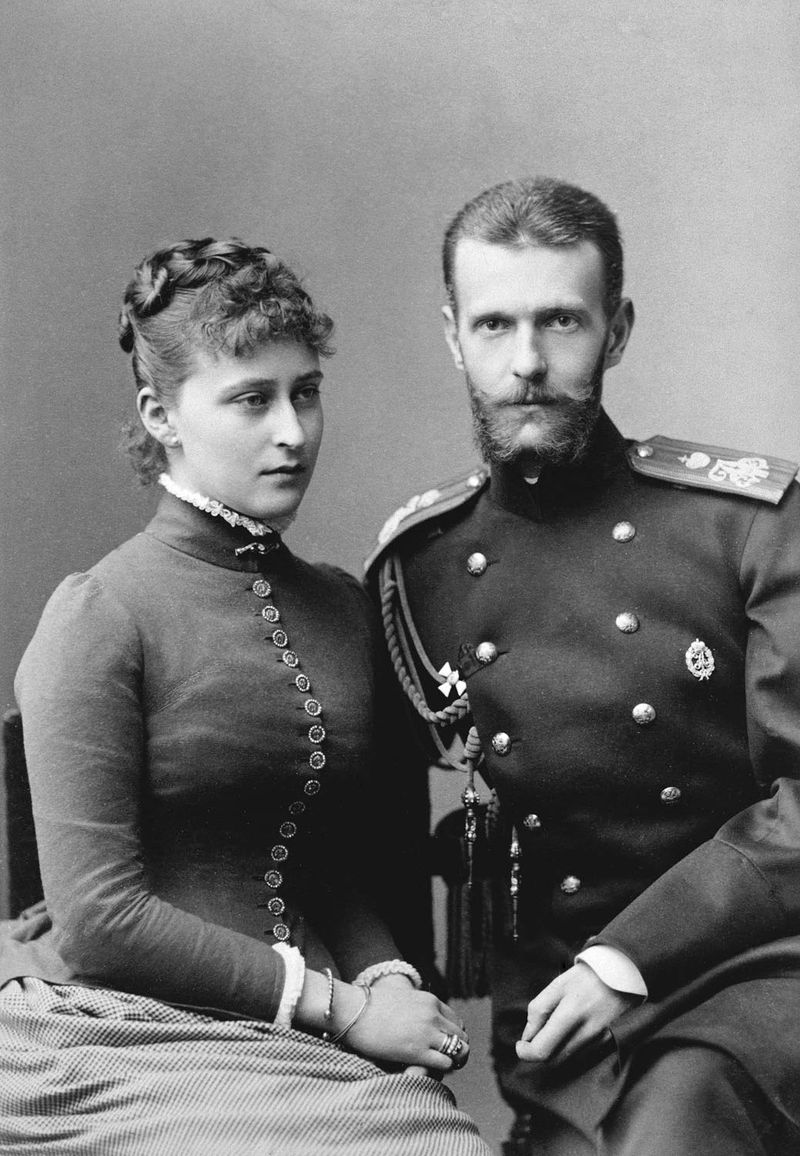
In 1891 Sergei was appointed Governor-General of Moscow. In the same year, without legal requirement and against the wishes of her German family, Elizabeth was received into the Holy Orthodox Church by chrismation, taking the patronymic Feodorovna. The decision cost her. Her father refused for a long time to grant his blessing. Her cousin Kaiser Wilhelm II of Germany declared the conversion to be motivated by vanity. Her grandmother in Windsor was sad. She made it anyway. It was the act of a woman who had begun to count what things were gain to her and to mark them loss for Christ.
The Kremlin gate
On the afternoon of the fourth of February 1905 [old calendar], Sergei Alexandrovich was killed instantly by a nitroglycerin bomb thrown into his carriage by Ivan Kalyayev, a member of the Socialist Revolutionary Party’s Combat Organisation, as he passed under the Nikolskaya Gate of the Kremlin. The explosion destroyed the carriage and mutilated her husband’s body. Elizabeth was inside the Nicholas Palace when she heard it.
She did not wait for a cloak. She ran out into the snow. Soldiers and policemen were already there, trying to cover what remained of her husband with their coats. She knelt in the bloodied snow at the Kremlin gate, and with her own hands, in front of a gathering crowd, she gathered the parts of his body into a cloth. He never liked mess, she said to one of those who stood by, and they carried what they had gathered into the chapel of the Chudov Monastery, where she prayed for him in her blood-stained clothes. That afternoon, before she allowed herself any private grief, she made a trip to the hospital. To visit Sergei’s coachman, who was dying of injuries from the same blast. How is His Imperial Highness? he asked her, and she answered, very gently, It is he who sent me to you, and stayed by his bed until he died.
A few days later she did one more thing. She went, alone, to the prison cell of the man who had murdered her husband. The conversation between them is not on the record, but its outline is. She brought a Gospel and an icon and laid them down at his cell. She asked him to read the Gospel. She told him she had nothing to do with earthly justice; that the destroyed body had been her husband’s, but the soul was now between him and God, and she could not bear that anyone, even her enemy, should die unrepentant. Kalyayev refused. He was hanged two months later. On the tombstone Ella set for her husband Sergei, she had cut the words: Father, release them, they know not what they do.
On her response
Russians thought she had gone mad with grief. Europeans thought she was performing piety. She was doing neither. She was practising, very early, the only Christian work that finally counts at the place of execution: forgiveness from the one who has been wronged. The Lord prays it from the cross. Stephen prays it under the stones. Elizabeth prays it at the Kremlin gate, at the foot of a bomb-shattered carriage, in a coat soaked through with the blood of the man she loved.
Encountering surrender
There is a kind of bereavement that ends a person; the door closes, the light goes out. There is another kind that opens them. Elizabeth’s grief opened hers. Four years after Sergei’s death, she wrote to her brother-in-law:
“I took it up not as a cross but as a road full of light. God showed me, after Serge's death, what years and years before had begun in my soul. It seems to me often that already as a child there was a longing to help those that suffer.”
She had begun to lay aside the marks of her former life almost from the day of the assassination. She had stopped eating meat or fish. She had asked that the unnecessary furniture be removed from her bedrooms and the walls be painted white. She had divided her royal jewels into three parts: one returned to the Crown, one given to Sergei’s surviving family, one sold for the work that was now visibly forming in her.
The Convent of Saints Martha and Mary
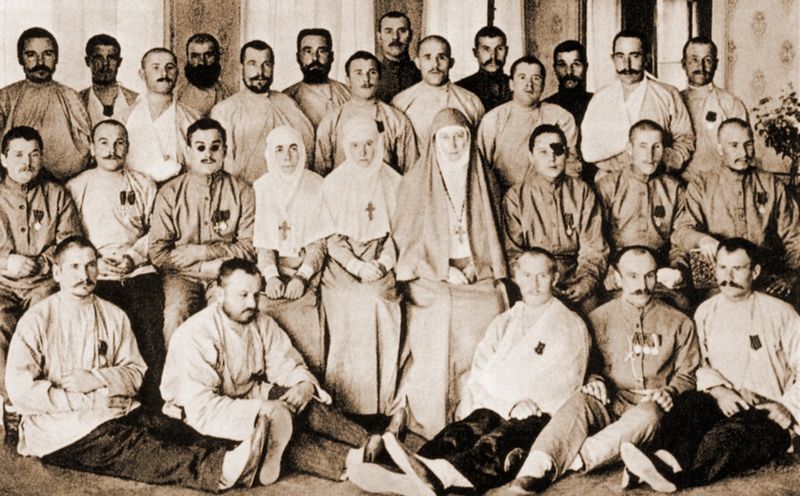
In 1909, with the blessing of the Russian Synod, she founded the Convent of Mercy of Saints Martha and Mary in central Moscow. The community took its name from the two sisters of Lazarus in Saint Luke’s gospel: one who sits at the Lord’s feet, one who serves at his table. The two are usually positioned as alternatives. Elizabeth insisted on holding them together. She believed that prayer and active service are a single harmony in two tones. The community was to pray and to serve. She wrote: I am espousing Christ and His cause. I am giving all I can to Him and our neighbours. I am going deeper into our Orthodox Church.
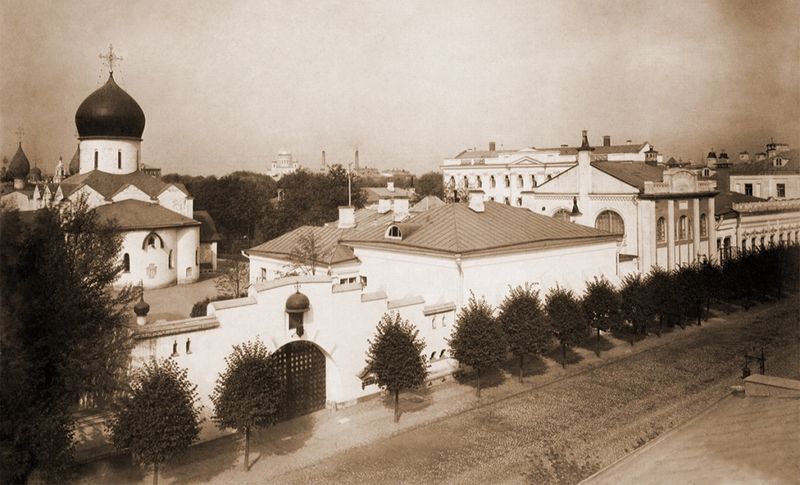
The convent at its height coordinated more than 150 charitable enterprises. There was a hospital, a clinic, a pharmacy, a chapel, a rent-free hostel, an orphanage, a school for nurses, a soup kitchen. The sisters worked in the Khitrovka, the worst slum in Moscow, where the police patrolled in pairs. Elizabeth visited the most dangerous streets herself. Many of those she nursed did not know who she was.
On the ninth of April 1910, in the church she had built, she took the veil of a nun. Thirty other women took it with her. Bishop Triphonius set the cloth on her head and said:
“This veil will hide you from the world, and the world will be hidden from you; but it will be a witness of your good works, which will shine before God and glorify the Lord.”
Inside the cell
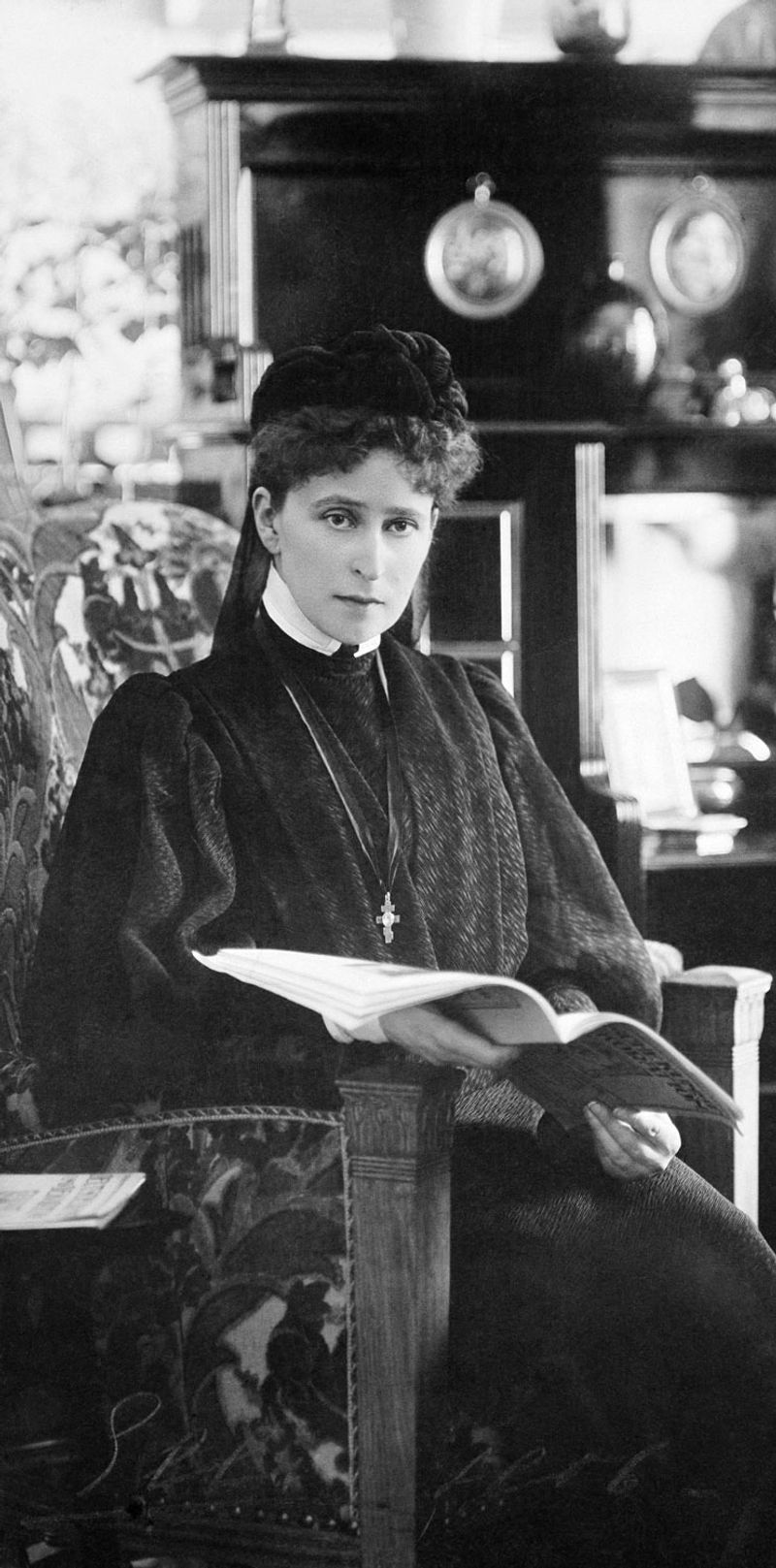
Her three small rooms in the convent had wicker chairs, a wooden bed without a mattress, a single pillow, and icons on the walls. She kept no jewels. She kept not even her wedding ring. The only ornament on her was a wooden cross on a white ribbon. She slept three hours when the nights allowed it; many nights they did not. When a patient died in the hospital wing, the night watch was hers. The Orthodox custom is that the Psalter is read unceasingly over the body in the time between death and burial. She read Psalters throughout nights in the dark.
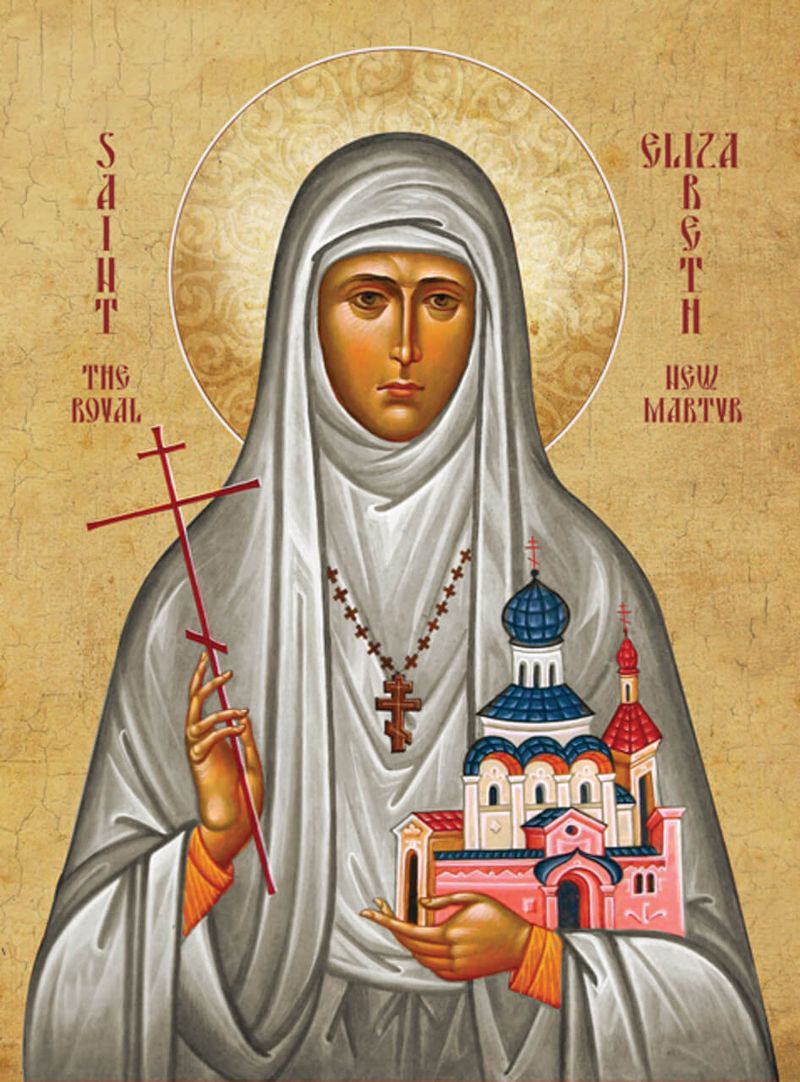
She also practised the Jesus Prayer. Her niece Princess Tatiana of Russia wrote later about an afternoon at the convent in 1915. The two had eaten lunch together with two recently-widowed cousins; the rest of the party went to rest. Tatiana sat at her aunt’s knees. Without a word for half an hour, she said, the Abbess looked down into her, and she felt that everything was understood, and that she was given strength. “Silently, without a single movement. After half an hour I rose, kissed her hand, and said, Thank you.” The Russian word that captures this is podvig, the ascetic struggle of presence and prayer that builds a person inwardly into the kind of person whose silence can carry a great weight.
The mob at the gate
One day in March 1917, Ella was now fifty-two years of age. With World War I underway and during the Russian revolution that dismantled the Tsarist autocracy and led to the rise of the Soviet Union, a lorry of armed men pulled up at the convent and demanded entry. A mob consisting of deserters, freed criminals, men who had been drinking. They said she was hiding German officers. Elizabeth sent the sisters into the church and went out alone to the porch. She told the men that five of them could come in and search, but only after they had laid down their rifles at the church door. She led them into the chapel, sang a brief moleben hymn with them standing bareheaded, and then walked them through the building. They went back to the others in the lorry and told them they had made a mistake. There were no German officers; it was a convent of nuns.
A journalist’s afternoon
In August 1917, on the same afternoon that the deposed Tsar and his family left Tsarskoe Selo on the long road to Siberia,
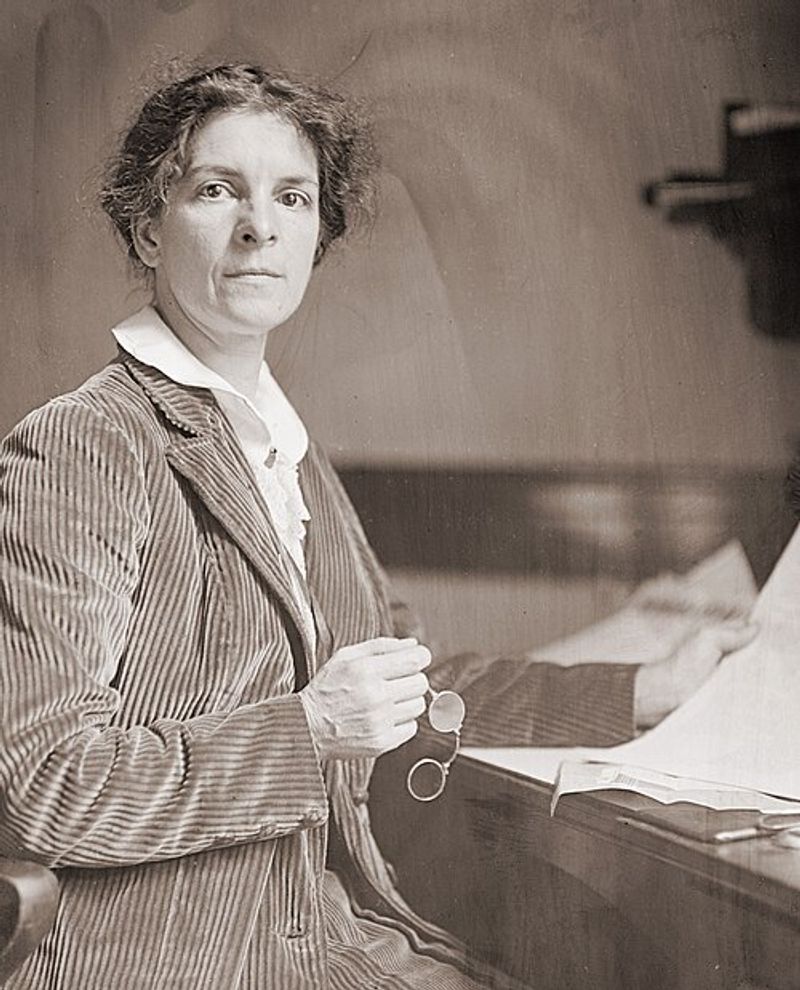
an American journalist named Rheta Childe Dorr rang the bell at the convent gate.
She had been told she would probably see the building and not the abbess. She was wrong. Elizabeth received her in a small parlour, in a willow chair with a blue cushion, and asked her about America. They spoke for three quarters of an hour, in English, on the public schools of Gary, Indiana, on the welfare of working women, on the aeroplanes the Americans were building, on Kerensky. Elizabeth said:
“I want my convent to be one of those busy, useful medieval types. Such convents were wonderfully efficient aids to civilisation in the middle ages, and I don't think they should have been allowed to disappear. We read the newspapers here, we keep track of events and we receive and consult with people in active life. We are Marys, but we are Marthas as well.”
The Russian people, she said, were good and kind at heart, but they were mostly children. Big, ignorant, impulsive children. If they could find good leaders, and learn obedience, they would build a strong new Russia. She prayed for Kerensky every day, she said. I am glad you like my convent. Please come again. You know that it does not belong to me any more, but to the Provisional Government, but I hope they will let me keep it.
Finding love
A second visitor came in the months that followed. The Swedish Minister at Saint Petersburg arrived at the convent gate bearing a message from her cousin Kaiser Wilhelm II of Germany, the boy who had begged for her hand at eleven, the man who had condemned her conversion.
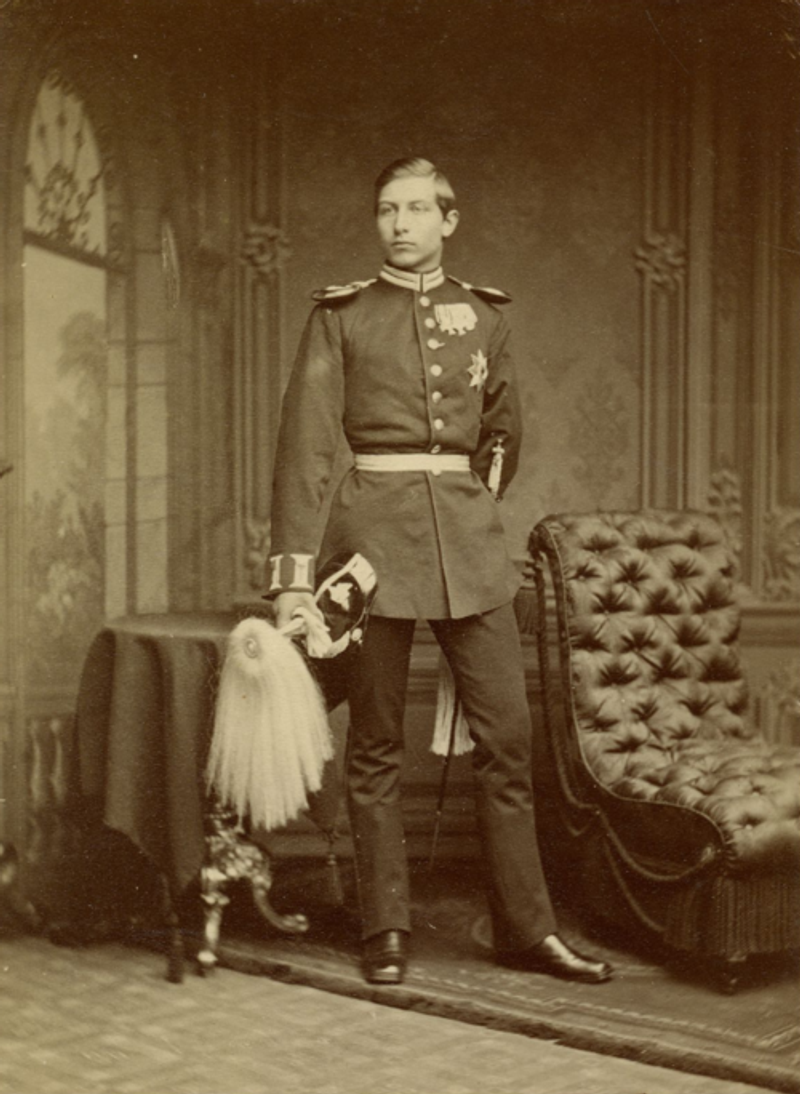
Wilhelm offered her safe conduct out of Russia and refuge in his country. She listened. She smiled a little. She refused.
She had become, by then, more Russian than the revolutionaries. She would share whatever fate her adopted country had. She would not leave the sisters of her community to face what was coming alone. The Swedish Minister left empty-handed. The next year she wrote a letter, which has survived, to a friend abroad. The country was in the middle of its bloodletting, the Tsar was already imprisoned, the convent itself was beginning to be encircled. She wrote:
“One must fix one's thoughts on the heavenly country in order to see things in their true light, and to be able to say 'Thy will be done,' when one sees the complete destruction of our beloved Russia. Remember that Holy Russia, the Orthodox Church, against whom the Gates of Hell shall not prevail, still exists, and will always exist. We work, we pray, we hope. Others are beginning to feel the same, and they come to our Church to seek rest for their souls. Pray for us, dear heart.”
To Alapayevsk
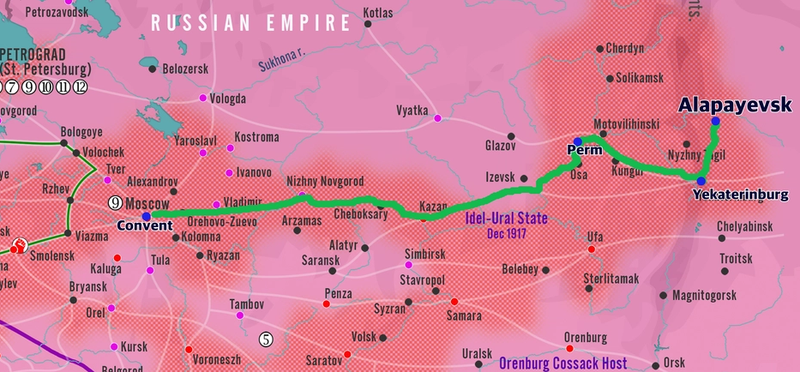
On Bright Tuesday of Pascha, 1918, the order came. She was to leave Moscow immediately, ostensibly to join her sister the Tsarina at Yekaterinburg. Two sisters were allowed to go with her: Sister Catherine and Sister Barbara Yakovleva, her cell-attendant of nearly a decade. She asked for two hours to prepare for the long journey. The Bolsheviks refused. She left her convent at night, under armed guard.
She did not go to her sister. She went first to Perm, then to Yekaterinburg, then to Alapayevsk, a small mining town about 250 miles north-east. There she was held in a converted schoolhouse with the Grand Duke Sergei Mikhailovich, the Princes John, Constantine, and Igor Konstantinovich, Prince Vladimir Paley, and Theodore Remez, the steward of Grand Duke Sergei’s estate.
From Perm she wrote to her nuns. The letter is short and entirely without panic:
“We are all going through the same experience and find consolation only in Him as we bear the cross of our separation. The Lord has found that it is time for us to bear His cross. Let us try to be worthy of it. I thought we would be so weak, that we would not measure up to bearing such a heavy cross. But the Lord giveth and the Lord taketh away. As it was pleasing to the Lord, so it happened. Blessed be the name of the Lord for evermore.”
At Alapayevsk the captives were able for some weeks to go to the church on feast days and to cultivate the garden of the school yard. They were also able to walk, under guard, in the town. By the end of June the guards changed. The new ones were ordered to be cruel.
The night of the eighteenth of July
On the night of the seventeenth of July 1918, the Tsar and his family were murdered in the cellar of the Ipatiev House at Yekaterinburg. In the small hours of the eighteenth, the ‘Cheka’ secret police then came for the captives at Alapayevsk. They drove them several miles into the forest, to the shaft of a disused iron mine. They beat them. They threw them, alive, into the shaft. They followed with hand grenades, covered the entrance with logs, and with earth.
The surrounding peasants reported that for several days they could hear prayers being sung from the mine. A participant in the murder recalled that after the first grenade was thrown into the mine, a troparion to the True Cross was sung from within: "Save, O Lord, Thy people, and bless Thy possession; grant victory to those who resist, and preserve Thy dwelling by Thy cross".
The post-mortem evidence noted: “Despite having been in the mine for several months, Grand Duchess Elizabeth Feodorovna's body was found almost completely intact. Her face retained a serene expression, and her right hand was positioned in a cross, as if in blessing.”
Elizabeth’s whole life had developed the strength for that final dark moment, and for that final prayer bringing light to the darkness.
The journey of her bones
On the eighth of October 1918, the White Army recovered the bodies from the shaft. Some of the wounds had been roughly bandaged, evidence that the captives had survived their fall and tended each other before death. As the Red Army advanced, the priest who had found them had the bodies carried in plain wooden coffins, across the Urals, across Siberia, across Manchuria. On the journey the priest noted that towards the end of the journey it was hot and humid and that from the coffins leaked a terrible stench except for the coffin of Elizabeth “The liquid that flowed from the Grand Duchess's coffin had a fragrant odor, and they carefully collected it in bottles as a shrine”. They were laid to rest first at Beijing, then at Shanghai, and finally, in 1921, in the Church of Saint Mary Magdalene in Gethsemane, on the Mount of Olives.
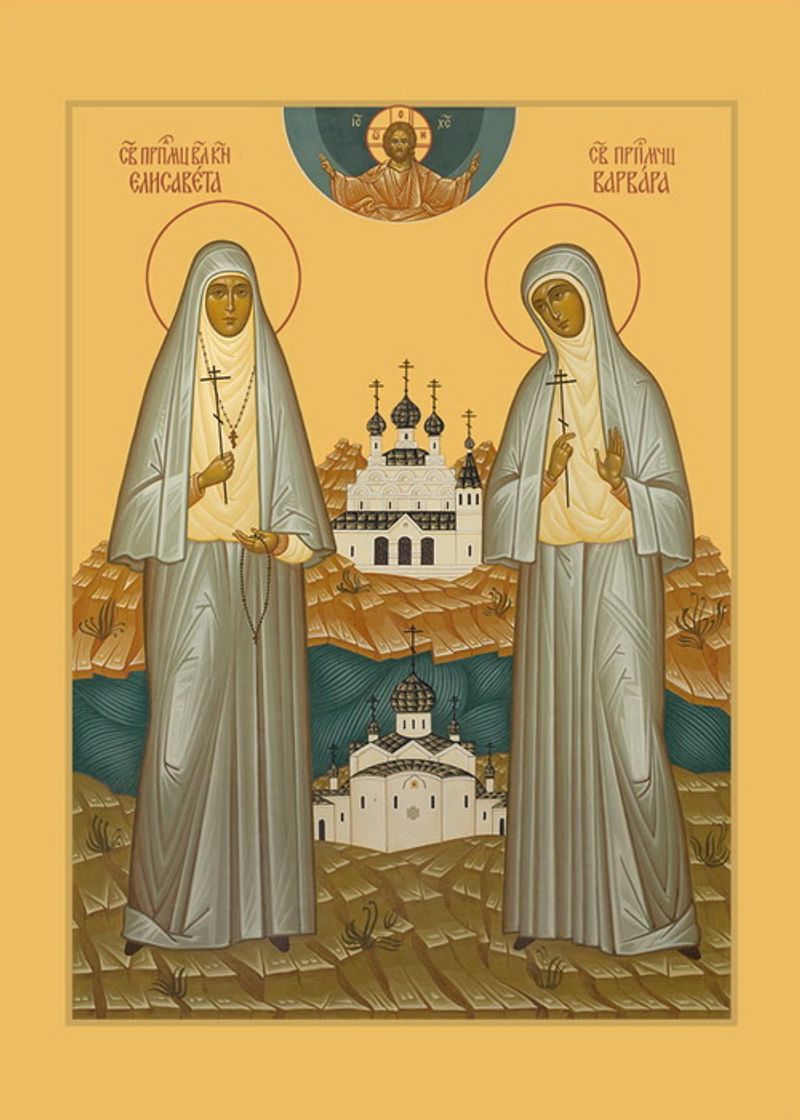
The Russian Orthodox Church Outside of Russia glorified her in 1981. The Moscow Patriarchate followed in 1992. When her reliquary at Gethsemane was opened in 1981, her body was found to be partially incorrupt, and sweet with the odour of sanctity. In 2004 and 2005 her relics were carried back through the country and the former Soviet states. More than seven million pilgrims came to venerate them. Patriarch Alexy II of Moscow called the pilgrimage Russia’s repentance.
Her statue stands above the Great West Door of Westminster Abbey, among the ten martyrs of the twentieth century. The garden of the convent she founded in Moscow holds another, with the inscription: To the Grand Duchess Elizabeth Feodorovna, with repentance.
The Novice Barbara: a closing word
The Cheka did not at first intend to kill Sister Barbara. She had come with Elizabeth from the convent. At Yekaterinburg they took her and Sister Catherine away from the Abbess and held them under interrogation. Both women asked to be returned to Elizabeth. On their knees, with tears. The Cheka refused. To frighten them away from the request, they offered Sister Barbara a condition: she would be allowed to return to her Abbess, but only if she signed a paper attesting that she was willing to share whatever fate the Abbess was about to be given. They expected her to flinch. The dialogue, recorded by Fr Nektarios Serfes from convent sources, was very short:
“I agree to give you the requested signature, not only in ink, but, if necessary, in my own blood.”
They had no answer for her. They sent her back to Alapayevsk. She died a few weeks later at the bottom of the mine shaft, beside the Abbess she would not leave. The Church remembers her on the fifth of July [old calendar] with Elizabeth, with Sergei Mikhailovich, with the Princes John, Constantine, Igor, and Vladimir, and with Theodore Remez. Her relics lie beside Elizabeth’s at Gethsemane. When the reliquary was opened in 1981, her body, like the Abbess’s, was found to be partially incorrupt, and with a sweet odour of sanctity.
Before she had ever taken the veil, Barbara had been one of the first sisters in Elizabeth’s community. She had been close to the Abbess for years, and her contemporaries said that she never took pride in the closeness, and that she behaved always as an ordinary nun.
“Greater love has no one than this, than to lay down one’s life for his friends.”
A word from this parish
We are a small Australian parish, named for two women who never came near our shore. We meet under the patronage of a German princess who became a Russian abbess, and a Russian novice who would not leave her side. Their lives have little in common with the everyday respectabilities of ours, except for the one thing that finally counts, our Faith. The lives they were given and what they gave back. Elizabeth was given a husband, a sister, a country, a freedom, the image of God and a calling to be like Him. She found in that surrender a love wide enough to forgive the man who had killed her husband, to forgive the men who beat and murdered them at the mine, the love for country that had been a part of her conversion and for the convent she had built with her hands. Her last words, recorded by witnesses, were the words of the Lord: Father, forgive them, for they know not what they do. They counted their gain, in the end, as loss for Christ.
Holy New Martyr Elizabeth, pray to God for us. Holy Novice Barbara, pray to God for us. Through their intercessions, Lord Jesus Christ, have mercy on us, and save us.
Footnotes
- 1.
The framing in three beats is taken from the essay New Martyr Elizabeth: facing loss; encountering surrender; finding love in the parish’s collected files, which itself draws on Fr John Chryssavgis on surrender as the central work of the spiritual life.
- 2.
Meriel Buchanan, Diaries and Letters: Grand Duchess Elizabeth, recording Princess Alice’s letter to Queen Victoria in November 1864.
- 3.
Ella’s letter to her grandmother, written from Darmstadt after the diphtheria deaths of her mother and sister May in late 1878.
- 4.
Buchanan, recounting eyewitness accounts of the assassination on 4 February 1905 by old calendar (17 February 1905 new calendar). The blood-soaked snow detail comes from Olsoufieff’s memoir; the cloth detail (“He never liked mess”) from the parish’s collected family material.
- 5.
Countess Alexandra Olsoufieff, History of HIH Grand Duchess Elisabeth Feodorovna (John Murray, 1923), reporting Elizabeth’s direct testimony of the prison visit.
- 6.
Letter from Elizabeth to Tsar Nicholas II, on taking up the work that would become the Convent of Saints Martha and Mary.
- 7.
The words of Bishop Triphonius (in the world Prince Turkenestanoff) at the veiling of Elizabeth and her first sisters on 9 April 1910, recorded in Olsoufieff.
- 8.
Rheta Childe Dorr, Inside the Russian Revolution (Macmillan, 1918), Chapter XV. An American journalist’s interview with Elizabeth in August 1917, on the day the Tsar left Tsarskoe Selo for Siberia.
- 9.
Elizabeth’s letter to her nuns from Perm, after the Bolshevik arrest, May 1918.
- 10.
Fr Nektarios Serfes, Martyrdom of Sister Barbara, the New Martyr of Russia (1999), reporting the Yekaterinburg interrogation.
- 11.
Patriarch Alexy II of Moscow, on the 2004–2005 tour of the relics through Russia and the former Soviet states, attended by more than seven million pilgrims.
About the Author

Bibliography
- Buchanan, M. (1958). Diaries and Letters: Grand Duchess Elizabeth.First-hand recollection by a daughter of the British ambassador in St Petersburg; she met and observed Elizabeth across many years.
- Olsoufieff, Countess A. (1923). History of HIH Grand Duchess Elisabeth Feodorovna. John Murray, Albermarle St..Memoir by Elizabeth’s Mistress of the Robes; the closest extant first-hand source on the founding and daily life of the Convent of Saints Martha and Mary.
- Millar, L. (1991). Grand Duchess Elizabeth of Russia. Nikodemos Orthodox Publication Society.
- Warwick, C. (2006). Ella, Princess, Saint and Martyr. John Wiley & Sons.
- Chryssavgis, J. (2006). On Surrender (Zenit interview).LinkSource of the parish’s ‘facing loss; encountering surrender; finding love’ framing.
- Dorr, R. C. (1918). Inside the Russian Revolution. The Macmillan Company, New York.Chapter XV records her interview with Elizabeth in August 1917; the only known American journalist’s first-hand account.
- Serfes, Fr Nektarios (1999). Martyrdom of Sister Barbara, the New Martyr of Russia.LinkThe most detailed account in English of the Novice Barbara’s witness alongside Elizabeth.
- Anthony, Metropolitan (Bloom) (1966). Living Prayer. Darton, Longman & Todd.Quoted in the parish essay on the relation between loss and love in the spiritual life.